
Virginia Resident Lookup Coverage Starts With Records
Virginia has no single public resident roll. The question determines which custodian can answer it, and each record covers a different slice of a person's life. The statewide layer can help cross local lines, but property, court, and tax records still depend on the county or independent city tied to the record.
| Record | What It Confirms | Where | Access |
|---|---|---|---|
| Assessment parcel | Titled owner, parcel, situs and mailing address | Local commissioner or assessor; VGIN parcel layer | Public fields vary; a parcel is not a household list |
| Deed or land record | Recorded transfer, parties, date, and legal description | Local circuit clerk; Virginia SRA/COVERS; archive | Index access varies; images and copies follow clerk rules |
| Voter record | Personal registration status, districts, and polling details | Virginia Citizen Portal; local registrar | Self-lookup needs authorization; list products are restricted |
| Court docket | Party, case type, filing date, and exposed status | OCIS 2.0; locality court system; clerk | Coverage varies; protected case material is excluded |
| Vital record | Birth, death, marriage, or divorce event | Virginia Department of Health; local issue point | Age rules apply; current copies need eligibility and ID |
| Probate or chancery | Executor, heirs, witnesses, and property links | Circuit clerk; Library of Virginia index | Public access varies by file and processing status |
| License or business filing | Credential or entity details and an address of record | DPOR; State Corporation Commission | Public search; dates and address fields need context |
Virginia property fields identify the owner of record, not every person at the situs address. A mailing address may be elsewhere, and a deed proves a recorded transfer rather than a person's current home. Start with the record that fits the question, then compare dates and locality before treating two entries as the same person.
Virginia Court Search Needs Local Context
Virginia Judicial System OCIS 2.0 searches defined criminal and traffic case groups across the state. It includes adult criminal matters in juvenile and domestic-relations courts, general district criminal and traffic matters, and select circuit courts. It is not a statewide search for every circuit civil case. The live statewide screen is JavaScript-driven, so a search that shows no row should lead to the locality's court page or clerk, not to a conclusion about the person.
The OCIS 2.0 search screen illustrates the statewide starting point. The Virginia Judiciary's e-filed case search guide documents the sample fields below; that result schema is not a promise that every local public portal displays the same columns.
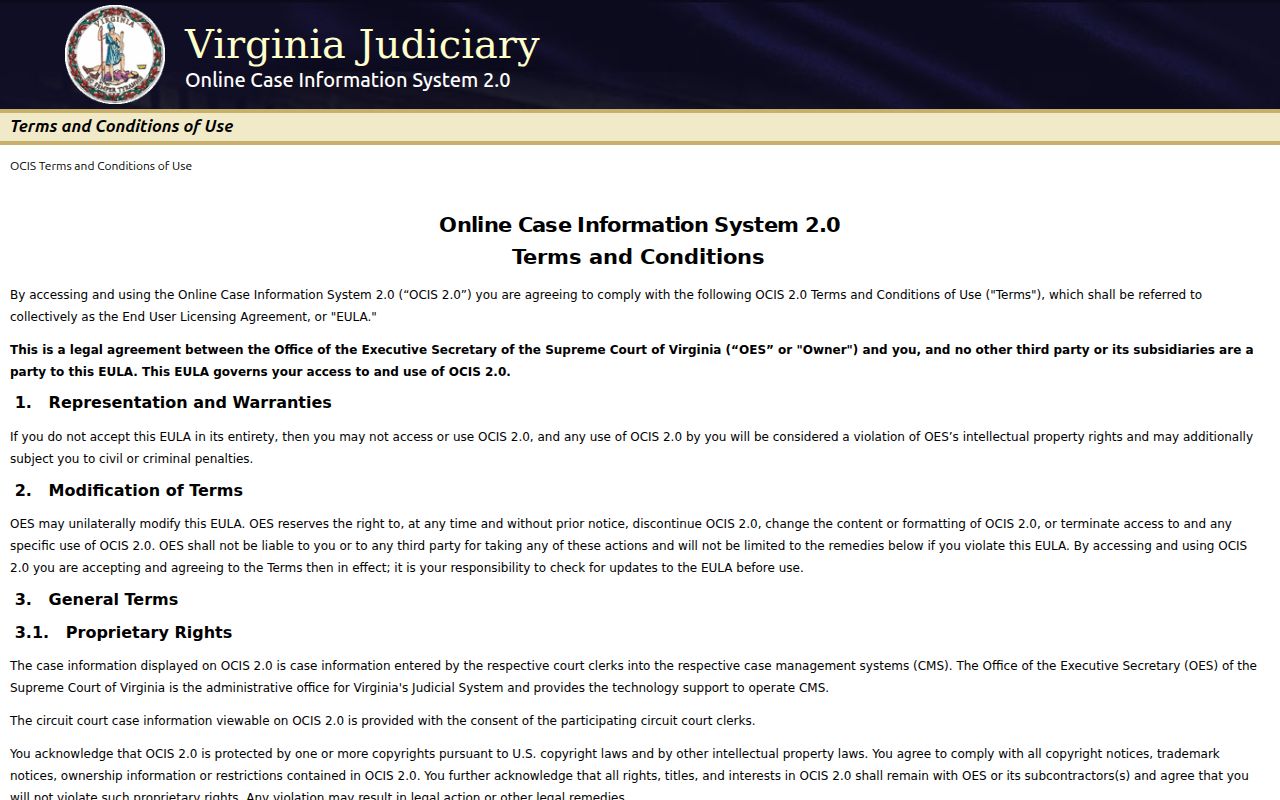
Use the locality, case type, filing date, and party role together. The image is only the search surface, while local clerks control access to the full court file.
| Search or result field | What it means | Limit |
|---|---|---|
| Court and search mode | Select a circuit court, then Party Name or Case Number in the documented e-filed interface | Local portals can use other controls |
| Search text | Last name first, comma and first name, or a partial surname | Spelling variants can change a match |
| Case number and party | Case identifier and indexed party name | A party name alone does not prove identity |
| Case style and type | Caption and local civil or criminal classification | Read the role and case type before drawing a conclusion |
| Dates and action | Date filed, date of final order, and the result action link | Disposition and full file access may require the clerk |
The Virginia Courts case-information directory routes researchers to local systems. Juvenile, sealed, expunged, adoption, and protected family material may be absent. A missing web result can also mean the local court keeps the index at its counter.
For a federal matter, PACER searches district-court dockets by party name, case number, court, and date. It requires an account and follows federal per-page fees, which can change. A federal result can show docket events, filings, judgments, and parties, but some documents remain restricted or redacted.
Virginia Voter Lookup Has Two Paths
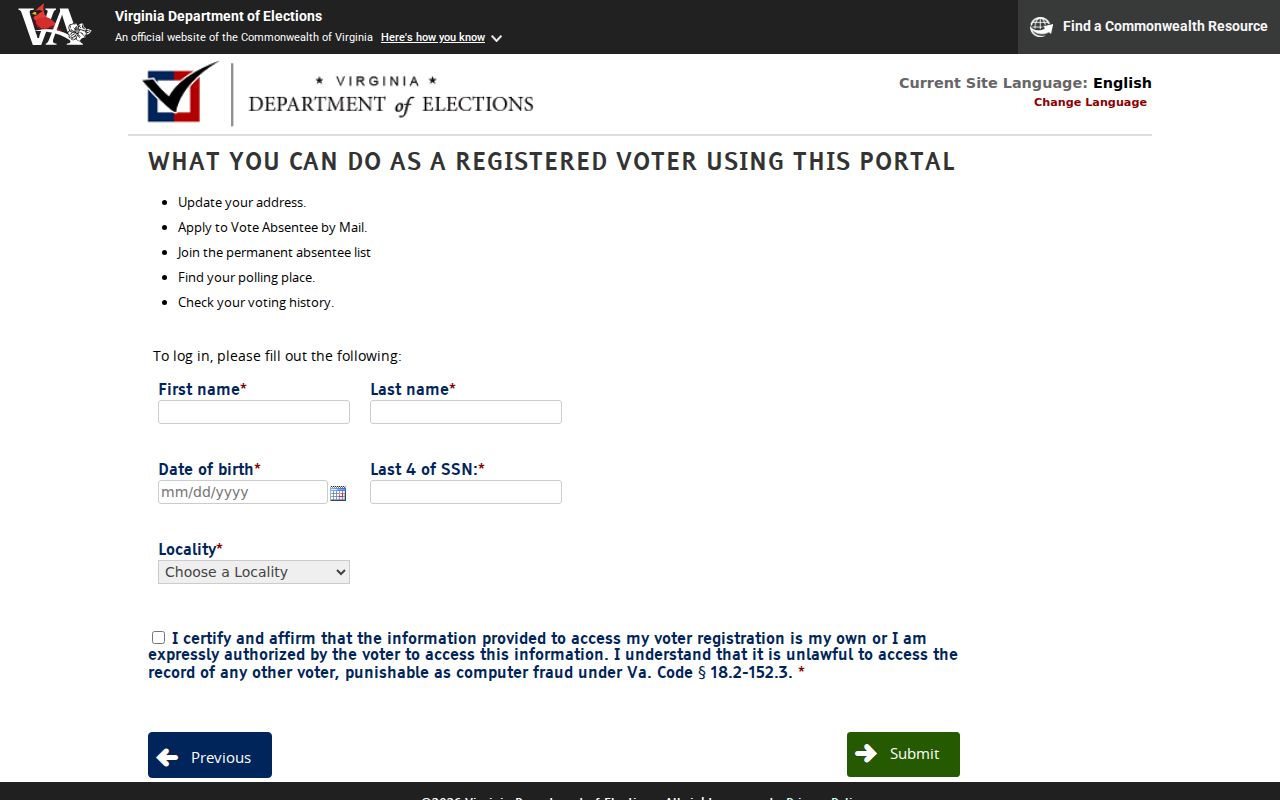
The Virginia Citizen Portal is a personal status check, not a public name-and-address search. It asks for first and last name, date of birth, the last four digits of SSN, and locality, then requires the user to affirm that the lookup is for them or that they are expressly authorized. That affirmation is part of the form. A Virginia voter lookup should not be used to test other people's names.
The Virginia voter-status form shows those controls and the authorization statement.
The separate voter-list process is governed by statute and has defined recipients and products. The voter-list request form asks for requester and organization, confirmed email, phone, client type, address, locality, district, election, start date, recurring months, and product. The Registered Voter List product includes full name, residence and mailing address, gender, full date of birth, registration dates, status, locality, precinct, voting districts, and voter ID number. Other products cover voters who participated in a chosen election, new registrations, monthly updates, four-year vote history, daily absentee applicants, and comprehensive absentee applicants. The form is emailed to info@elections.virginia.gov, requires an active confirmed organizational email, and has no universal price; ask Elections for a current estimate.
| Citizen Portal field | Required or option | Purpose |
|---|---|---|
| First name and last name | Required text | Identify the user's voter account |
| Date of birth | Required date or text | Match the personal status record |
| Last four of SSN | Required text or numeric | Matching credential, not a public list field |
| Locality | Required dropdown | County or independent city for registration |
| Authorization affirmation | Required checkbox | Confirms self-use or express authorization |
| Previous and Submit | Portal buttons | Move back or run the personal lookup |
Under Va. Code §§ 24.2-405 and 24.2-444, public-inspection lists may show name, address, year of birth, gender, and election districts, but not SSN, day and month of birth, protected residence addresses, or excluded registration details. Candidates, party committees, PACs, incumbents, qualifying nonprofits, courts, and members of the public seeking to promote voter participation by mail or communication without intimidation or pressure may qualify for defined products or inspection. The product's full date of birth is not part of the public-inspection list. A recipient cannot publish a list as a searchable Internet database or pass it to another party for that purpose. Virginia does not register voters by party in the ordinary statewide record, and the list is not a record of ballot choice.
Status may change after a move, cancellation, list maintenance, death report, duplicate entry, or address check. A protected voter may have a PO box or no public residence field. Historical poll books and registration records are local or archival research: the Library of Virginia election-records guide and its locality microfilm directory identify material where preserved. Old lists may have been destroyed when a new complete list arrived. Aggregate election counts are not person records, and no match in the personal portal does not prove that someone never lived in Virginia.
The Virginia Same-Name Trap
Virginia indexes can split a trail across counties, independent cities, and towns. A postal city may differ from the legal locality, while a road renumbering or annexation can change how an older address appears. Virginia historical records can also use initials, maiden or married names, suffixes, spelling variants, or naming conventions that changed over time. Do not merge two entries just because the names match.
For a one-person resident lookup, compare at least two independent record families and retain the dates and places that support each match. A parcel owner, court party, license holder, or voter record answers a different question. When the goal shifts from one person to the people tied to a full address, the Virginia street directory walkthrough follows the address records in more depth.
Verify a Virginia Resident Across Records
For a Virginia resident lookup, the safest check is a small chain of official records that agree on locality and date. Use the parcel and court entries to create leads, then test those against an independent record family. Do not use a commercial compilation or one same-name result as proof.
- Write down the full name and variants, including initials, former names, suffixes, and spelling changes shown on records.
- Anchor the name to a Virginia locality with a parcel record, an authorized voter self-check, a business filing, a license address, or a court locality.
- Compare at least two record families, such as a parcel and a docket, or a directory entry and a deed. Check the date and the person's role in each.
- Keep the search terms and retrieval date. If an official field is wrong, ask the record custodian for its correction process.
- Request a certified copy only when you are eligible and need an official copy; an index result is not the full record.
- Docket
- A court's list of case events, parties, and filings. A public search result may show only part of it.
- Index and image
- An index points to a record using names, dates, or numbers. An image is a view of the underlying page, when the custodian makes it available.
- Certified copy
- A copy authenticated by the custodian as an official copy. A screen print or index entry is not certified.
Virginia Vital Records Open by Age
The Virginia Department of Health Office of Vital Records keeps the statewide birth, death, marriage, and divorce records. Birth records open to the public 100 years after the event. Death, marriage, and divorce records open after 25 years. Current restricted copies generally require an eligible relationship and valid identification, so an index clue does not mean that anyone may order the certificate.
VDH lists birth and death holdings for 1853-1896 and June 1912 to the present, with a 1896-1912 gap; marriage coverage begins in 1853 and divorce coverage in 1918. A marriage license is issued by the circuit court for the place of application, while the later certified record is held by VDH. Local health districts and full-service DMV centers can issue some eligible certificates.
The VDH forms page links to the current application types and processing routes.
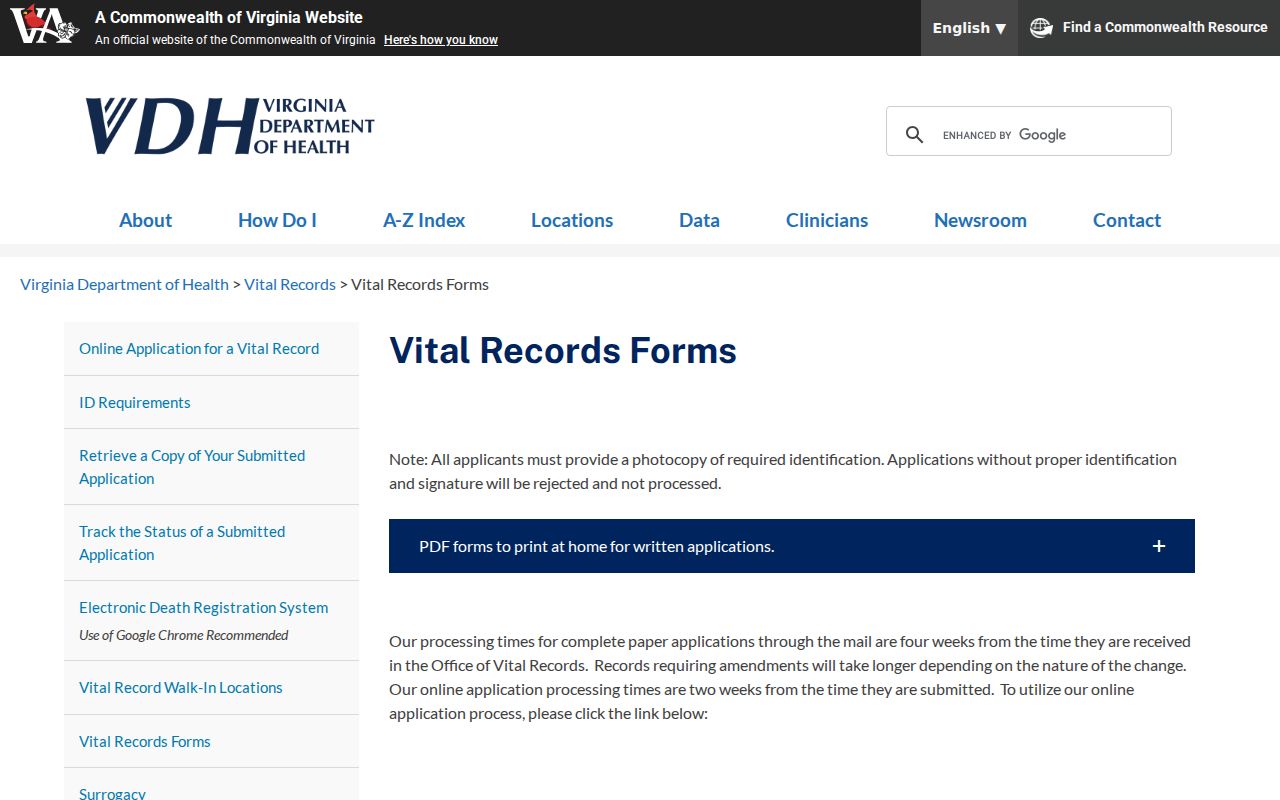
The birth form asks for the person's birth name, any changed name, date and Virginia city or county of birth, hospital, sex, and the mother's or parent one's full maiden name and father's or parent two's full name. It also asks whether an amendment is needed and for its code; a JCO code can require a court-approval response.
Other visible birth-form fields include:
- Requester phone, text-notification choice, name, email, business name if applicable, and street and mailing address.
- Relationship to the person and the reason for the request.
- Short-form, long-form, foreign-birth, or delayed-birth certificate type and total and type-specific copy counts.
- Amendment or correction choice and code, signature, false-application warning, and an enlarged legible ID copy.
- Payment of $15 per certificate or search by check or money order to the State Health Department.
VDH requires one primary ID or two secondary IDs and an unsigned form is not processed. The State Registrar may accept or deny an application under § 32.1-271(C). Mail applications to Office of Vital Records, P.O. Box 1000, Richmond, VA 23218-1000; in-person service is at 8701 Park Central Drive, Suite 100, Richmond. Customer care is (804) 662-6200, with weekday hours from 7 a.m. to 4 p.m. A complete paper request usually takes about four weeks and an online request about two weeks. VitalChek's express service is typically two to five days and adds service and delivery fees. Local health districts may offer same-day pickup; full-service DMV centers issue eligible certificates with a $17 search fee for that transaction. A Verification of Death for someone who does not qualify for a full copy requires direct and tangible interest and shows only the decedent's name, date and place of death, birth date, and last four SSN digits. Stillbirth certificates are limited to a parent on the fetal-death report; eligible requests for an event of at least 20 weeks after July 1, 2022 have no fee.
Virginia Heirs and Classmates Need Different Paths
A search for an heir should begin with probate or will records at the circuit clerk, then move to deeds, an obituary, cemetery material, or a chancery cause if the first record leaves a gap. The Library of Virginia's Chancery Records Index covers more than 100 localities and can include heirs, witnesses, relationships, and property descriptions. Each locality has its own date range and image status.
For a former classmate, try published yearbooks and school or university archives, then compare the entry with a later public record. For birth-parent information, use VDH's birth-parent contact-preference and adoption-related forms, the official adoption process, or a legal representative. A public directory is not a substitute for a confidential intermediary. In Virginia, these routes can support family history or reconnection without turning a public record into a claim about a private person.
Virginia Licenses and Other Official Leads
The Virginia Department of Professional and Occupational Regulation search can return a licensee's name, license number, address of record, type, rank or classification, issue and expiration dates, and status. Its electronic list refreshes every five business days, though the displayed result may lag the physical record. Open complaints are generally not public until probable cause. For a mismatch, report the exact field and lookup date to DPOR License Lookup or ask the department about its records process.
The State Corporation Commission's Clerk's Information System can show a business entity's ID, legal name, type, address, and formation or status dates. That address may belong to an agent or entity, not to a resident's home. Use the SCC CIS search to follow an entity filing, then keep the business address separate from a personal address.
For a separate Virginia State Police record-check request, the SP-167 request system asks for request type, purpose, name, date of birth, race, sex, SSN, contact and recipient details, and payment; the affidavit portions require notarization. A mailed request normally takes about 15 business days. The stated fee is $15 for a Virginia record check or $20 for a combined criminal-history and registry search. This is a state repository check, not a court docket or file image.
For the narrower question of state custody or supervision, the Virginia Department of Corrections locator takes a name or seven-digit DOC ID; advanced filters include location, race, gender, and age range. It updates daily, but results can still be old or wrong. The VADOC locator shows its search controls.
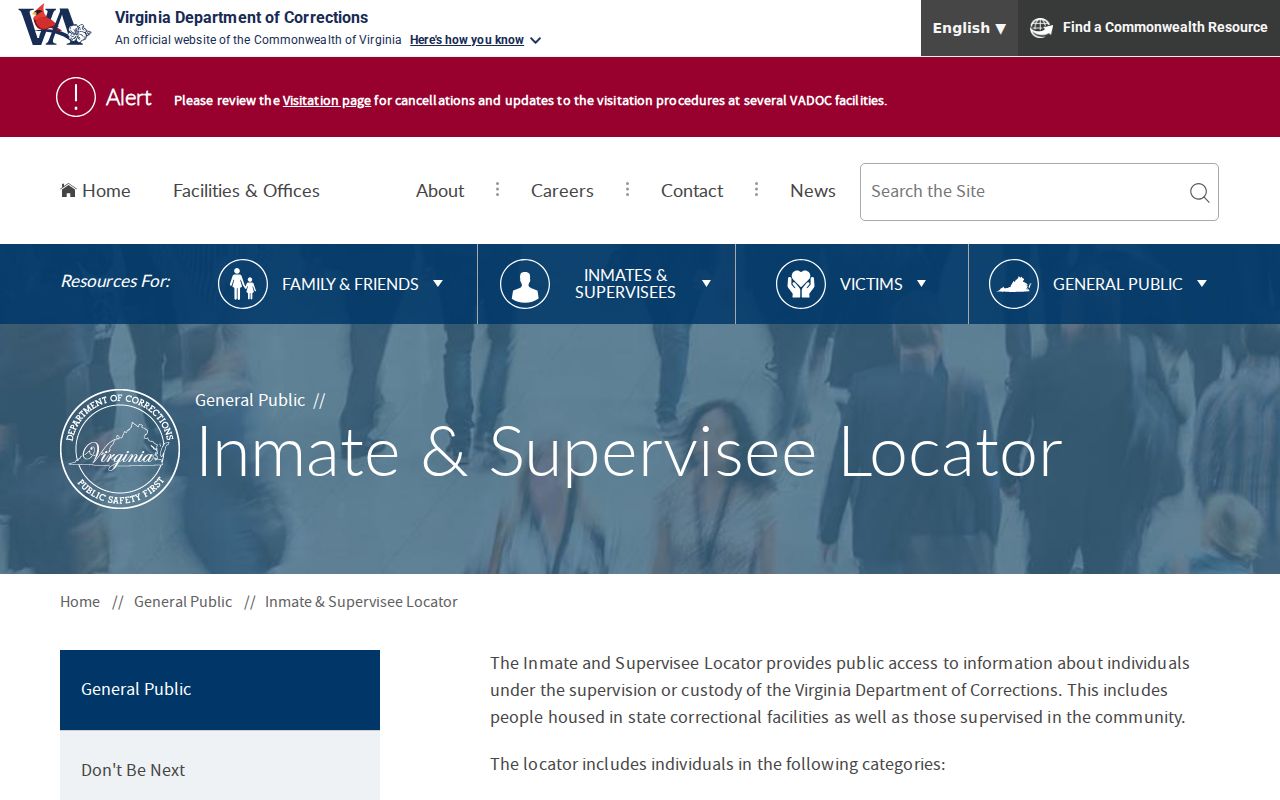
A locator result is not a complete history or proof of a current address. Verify any result with the responsible custodian and do not treat a similar name as the same person.
Virginia Resident Lookup Has Privacy Limits
Virginia records are open by record type, not as permission to assemble or publish a full profile. The Address Confidentiality Program gives eligible survivors a substitute address and mail-forwarding protection. Election law also lets certain protected voters and household members use a post-office box in place of a residence address. A blank result or alternate address can be a safety measure, not a data error.
The Virginia Consumer Data Protection Act, Va. Code §§ 59.1-571 through 59.1-581, gives covered consumers rights to confirm processing, access, correct, delete, and opt out in specified circumstances. It does not erase a recorded deed, court docket, or archival newspaper. The Address Confidentiality Program is established by Va. Code § 2.2-515.2. A correction must go to the original custodian: VDH for a vital record, the registrar for a voter entry, the local commissioner for an assessment, the clerk for a court record, or DPOR for a license. Describe the record number, date, disputed field, supporting proof, and requested fix.
Lawful personal use. Use a Virginia resident lookup for a lawful personal reason, such as family history or verifying a record. Do not use public information to follow, threaten, or repeatedly contact someone; Virginia law addresses stalking conduct under Va. Code § 18.2-60.3.
When Virginia Records Are Missing
First identify the county or independent city that holds the record. Use the property locality for a parcel, or ask the Virginia courts directory which clerk handles the case. If an online circuit search has no result, contact the local clerk about its public terminal, index cutoff, archived files, copy rules, and any fee before visiting. Virginia circuit clerks are the custodians for court files; those requests do not follow the ordinary agency FOIA route.
For another covered public body, make a narrow Virginia FOIA request under Va. Code § 2.2-3704 that names the record, person or parcel, date range, and likely office. The body must respond within five working days. It may provide the record, cite an exemption, say it does not exist or cannot be found, or use up to seven more working days when needed. Charges are limited to actual search, access, duplication, or supply costs; ask for an estimate, and a deposit may be required when the estimate is over $200. FOIA does not make an agency create a new resident list or disclose protected fields.
When a record predates online access, ask the clerk or local library whether it was transferred to the Library of Virginia or another archive. Keep the name variants and failed search terms, then check the custodian's own correction route if you found an error. A resident lookup should end when the trail reaches a protected address or asks for information the custodian cannot lawfully release.